emovation® is a platform for analysing, shaping, and managing the emotional impact of a brand. It makes the resonance between a brand and its audience visible and actionable. Based on the Brand Motive Profile, organisations can clearly define the emotional response their brand is intended to evoke.
The platform evaluates every measure using the emovation® method, assessing both Brand Fit and audience response – from strategy through to dialogue-driven formats. This enables marketers to ensure that their brand’s impact is translated consistently across the entire Customer Journey.
I see something you don’t see.
Your data shows what people do: clicks, interactions, purchases, or drop-offs. Yet crucial questions remain unanswered. Which emotion was activated? Why did it lead to this behaviour? And why does it work for that brand – but not for ours The answers to these questions are essential for managing brands proactively. Because before someone chooses a brand – whether in their mind or in their gut – guiding motives are already at work.
«emovation® follows a simple logic: understand motives, make resonance visible, evaluate impact, and make well-informed decisions.»
This is precisely where emovation® comes in. The platform reveals the emotional resonance linked to hidden needs and translates it into a Motive Profile. On this foundation, strategy, content, and brand experiences can be developed with clear direction from the very beginning – creating a brand that is both emotionally relevant and truly effective.
Intuitive tools. Clear decisions.
emovation® makes the emotional impact of your brand visible – and enables you to manage it with precision. Systematically evaluate marketing initiatives for Brand and Customer Fit, and guide your brand’s emotional impact consistently across the Customer Journey.
The emotional Motive Profile reveals, through a target–actual comparison, which motives your brand strategically aims to activate – and which are actually triggered. This makes positioning gaps visible and helps identify motive-based sweet spots for stronger brand resonance.
A deeper analysis across audiences and segments. You gain clear insight into how different groups respond to your brand and your initiatives – and where Brand Fit is particularly strong or weak.
The ERS makes emotional impact measurable. It shows how well an initiative aligns with your brand and enables comparable evaluations – for example across dialogue concepts, campaigns, assets, or experience formats.
All results are compiled into a structured report. Export your analysis as a PDF – providing a solid foundation for internal decision-making and a clear briefing for external agencies and partners.
-
Image
 Brand positioning and Motive Profile in a target–actual comparison
 -
Image
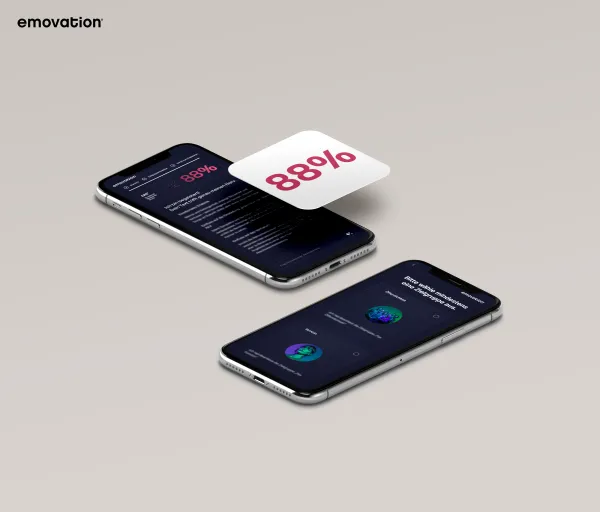 Resonance analysis for your selected audience
 -
Image
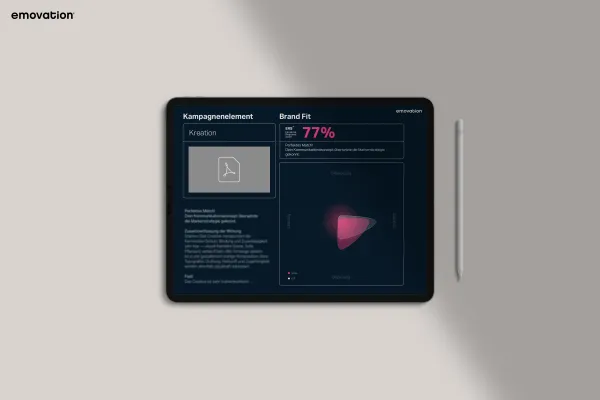 Export your Brand Fit evaluation as an analysis report


Emotional resonance is now measurable.
The analysis is based on three complementary perspectives: quantitative data from association networks, qualitative insights from in-depth personal interviews, and data analytics derived from company data, market data, and the digital public sphere. Each of these perspectives illuminates a different aspect of brand resonance.
The emovation® methodology connects these perspectives within an integrated analytical model. Through their systematic combination, the emotional fingerprint of your brand emerges – a structured Brand Motive Profile that reveals which hidden needs are genuinely being activated.
«emovation® does not simply measure perception or satisfaction. It measures the emotional resonance between a brand and the audience’s underlying motive system.»

Only by connecting these different perspectives can you see which emotional drivers strengthen your brand, where tensions arise, and where activation fails to occur. The result is not a snapshot of sentiment. Not a trend report. But a robust foundation for well-informed decisions.
Emotional Response Score (ERS) as a new strategic metric
Based on this analysis, emotional resonance becomes systematically measurable for the first time. The Emotional Response Score (ERS) translates the Motive Profile into a strategic metric. It shows how strongly a brand, an asset, or an experience activates motives – and which hidden needs are being addressed.
The ERS does not replace traditional KPIs. Instead, it complements them with what performance data cannot capture: the emotional resonance that ultimately drives decisions. In this way, emotional brand impact becomes not only visible, but also deliberately manageable.

«Data shows what happens. The why determines what truly works.»
Where emovation® unlocks its full potential
emovation® provides the analytical and decision-making foundation behind our services. The Motive Profile and the Emotional Response Score® (ERS) reveal where and how brands create emotional resonance – from strategic positioning to activation across the Customer Journey.
Brands do not create impact at a single touchpoint, but through the interaction of many decisions. Within this dynamic space of influence, emovation® supports strategic decision-making in the following areas:
Which positioning activates sustainable needs – and which merely generates attention? emovation® reveals which motives strengthen a brand over the long term and where genuine strategic resonance emerges. Different positioning options can be compared before they are established in the market.
Which emotional drivers are activated by your brand design? emovation® reveals the actual impact of design, language, and visual identity. In this way, brand design becomes a strategic decision about impact – not merely a question of style.
Which content truly activates the motives of your audience? emovation® makes visible which variants create stronger resonance – and why. With the ERS, campaigns, assets, and formats are no longer evaluated by preference, but by their motive-based impact. Testing reveals which version delivers more sustainable results.
Which needs are truly activated along the Customer Journey? emovation® shows which brand experiences generate resonance – and which remain ineffective. Live experiences are moments of concentrated impact. emovation® reveals whether encounters create emotional connection – or simply impress.
Which cultural motives build long-term talent commitment? Not every employer message creates genuine engagement. emovation® reveals which needs are sustainably activated – and which remain untouched.
Which motives shape the real decision logic of your customers? emovation® identifies the drivers behind purchasing decisions – and makes them actionable for sales, offers, and communication.
Analyse your brand with emovation®
Understand which motives your brand activates – and how resilient its impact is.

emovation® is an analytical and decision-making model for emotionally driven brand management. For you as a client, it represents both our methodology and our digital platform. With emovation®, we identify hidden needs and motivational drivers that shape behaviour – and make them visible, measurable, and manageable for brands. This creates a robust foundation for strategic decisions across the entire Customer Journey.
The ERS indicates how well a measure aligns emotionally with your brand. It does not measure the intensity of an emotion, but rather its fit with the brand strategy. Based on a structured motive system, the ERS reveals which motives are actually activated – and complements traditional KPIs by uncovering the motivational drivers behind behaviour.
Traditional KPIs measure behaviour: clicks, reach, conversions, or repeat purchases. The ERS measures the emotional activation that underlies this behaviour. KPIs show what happens. The ERS shows why it happens. Only the combination of both perspectives enables well-informed brand management.
emovation® is based on a structured motive system with four need spaces and 16 motives. These form the foundation for systematically analysing hidden needs and motivational drivers. The model is complemented by quantitative sentiment analysis as well as societal lifestyle models – including the 18 lifestyles developed by the Zukunftsinstitut, which are continuously refined and evaluated.
Hidden needs are identified through qualitative in-depth interviews and structured meaning analysis. The number of interviews follows scientifically established saturation criteria in qualitative research:
- 6–8 interviews per clearly defined target group reveal initial stable patterns
- 10–15 interviews generally lead to a high level of thematic saturation
- 20+ interviews typically provide only marginal additional insights – except in very heterogeneous groups
(Guest, G., Bunce, A., & Johnson, L., 2006)
The insights are systematically analysed and translated into the motive system. This results in reliable patterns rather than isolated interpretations.
emovation® combines several data sources to analyse emotional resonance systematically:
- Market and customer data, such as analytics, CRM systems, basket analyses, or campaign performance
- Qualitative in-depth interviews to identify hidden needs and motivational drivers
- Quantitative sentiment analysis of publicly available online data
For sentiment analysis, trained language models are used to analyse large datasets in real time for recurring association and motive patterns.
Crucially, it is not the volume of data alone that matters, but its structured consolidation within the motive system. Only this integration enables reliable insights into emotional drivers.
No. Artificial intelligence is used within emovation® as a supporting tool – for example in language and sentiment analysis of large datasets. However, emovation® itself is not an AI tool, but a structured analytical and decision-making model based on a clearly defined motive system.
Traditional AI twins simulate individual personas based on historical data, modelling how a specific person might respond. emovation®, by contrast, does not create digital replicas of individuals. Instead, it analyses the hidden need structures of entire audiences and identifies the motivational fit between brand and audience. The focus lies not on simulation, but on creating robust foundations for strategic decisions.
No. emovation® does not replace traditional market research – it complements and structures it. While traditional research measures perception and behaviour, emovation® analyses the motivational drivers behind decisions. Combining both perspectives creates a far more comprehensive understanding of brand impact.
emovation® is designed for everyone who develops, manages, or leads brands – particularly in strategy, marketing, communication, Live Marketing, sales, and Employer Branding. It is especially valuable for organisations that do not only wish to optimise outcomes, but also want to understand and actively shape the mechanisms behind brand impact.